Five Princes
His Property (A Dark Vampire High School Bully Romance) (Vampire Boy Swords): Prince of Londinium (Dead Sun: Prince of Londinium (A Dark High School Bully Romance) (Vampire Boy Swords) Book 1)The Five Princes form the royal advisory and protective order at the center of the old Taleian monarchy. Chosen through the Book of Talus as fated mates and advisers, they were appointed to guard the Empress’s immense power and keep her loved and safe. Their murder, alongside the Empress and her child, becomes one of the concealed crimes behind the present imperial regime and helps explain why the ancient bonding system survives only in distorted, muted forms.
Royal Origin and Function
The Five Princes belonged to the political structure governed by Morrigan, the Queen of the first royal clan. In the account of ancient Briton, the Taleians were divided into clans, and the Breannin Clan constituted the second royal clan, from which the Queen’s Knight of Swords and her knights were drawn. The Princes therefore combined dynastic proximity with a martial tradition: Taleian men were renowned warriors, expert swordsmen, and exceptionally strong, while the broader royal order was sustained by the psychic gifts associated with Taleian women.
Their role was not merely ceremonial. The Empress possessed the DNA strands of all the Taleian people, and the Five Princes served as her mates and advisers, protecting both her physical security and the political value concentrated in her person. Their relationship to her joined intimacy, counsel, guardianship, and succession. The old system thus treated royal government and mate selection as interlocking institutions rather than separate spheres.
The Book of Talus and Mate Selection
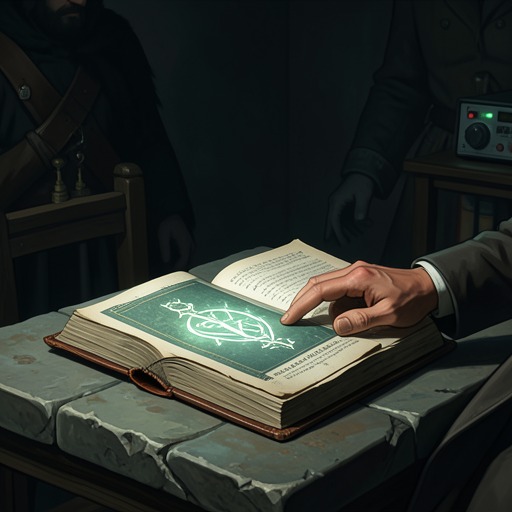
The Five Princes were connected to the Book of Talus, a magical book that selected a Taleian’s mate from birth. At the child’s birth, a name appeared in the book, with the name of the designated fated mate written beside it. The source of this knowledge was unknown, but its authority was treated as decisive: the book supplied both companions and advisers for the Empress’s court.
The bond it prescribed was psychic as well as political. Before the union could be consummated, the fated mates had to establish a psychic bond through several duels, allowing their thoughts to flow as one. Six sword duels against designated challengers had to be won before the bond could be completed, and the mate had to defeat every challenger to keep the prize. This requirement made the Princes’ position inseparable from martial legitimacy. A royal companion was not simply selected; the claim had to be defended through combat.
Destruction of the Original Order
The Queen and the Knight of Swords were murdered by the Druids while attempting to help their people with the aid of the Magician, the Queen’s powerful magical adviser. The Five Princes and the Empress’s child were also killed in the larger purge attributed to the Emperor. The crime destroyed the visible guardians of the old regime and severed the continuity through which the Empress’s authority had been protected.
The political consequences reached beyond the deaths themselves. According to the historical account, the hybrid population had helped the Taleian people survive their evolution, and aliens had joined with them as well, yet the Emperor wanted no reminder of the Empress’s rule. He rejected the legacy of the Empress and the Five Princes, whose guidance and nurture were remembered as having benefited the people. His attempt to erase them was therefore also an attempt to erase the system of legitimacy they represented.
Legacy in the Present Court
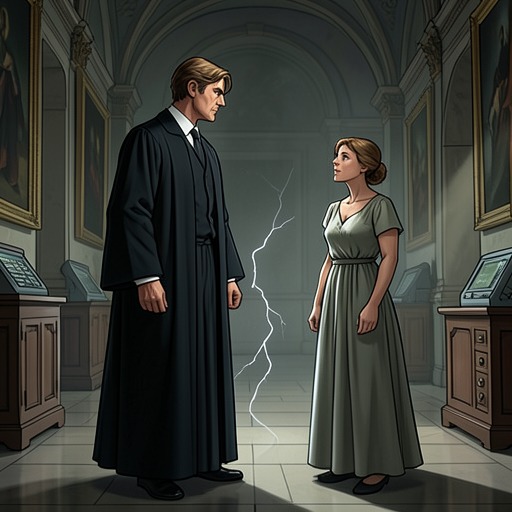
Although the Emperor sought to suppress the old heritage, some Taleians continued to feel the pull of its traditions. The ancient bonding ritual remained recognizable even in a muted form, and the court’s rule of courtship could be invoked as a claim over Clara Driscoll. Byron Phraeon argues that a kiss has staked his claim according to that rule, while Darius Constantine rejects the gesture as insufficient and insists that no bond has been initiated. The dispute shows how the Five Princes’ legacy persists as a competing normative order: imperial authority may denounce the old customs, but court figures still use their language to justify possession, protection, and desire.
The surviving practice also retains the coercive structure of the original system. The ritual requires the male mate to win six sword duels before the bond is consummated, while Clara Driscoll objects that women appear to have no say in the process. Her protest exposes the distance between a tradition described as sacred or fated and the consent of the person whose body and future it governs. The Five Princes’ institution consequently survives not as an intact political body, but as a contested rule system whose authority is invoked by men and challenged by the woman at its center.
Historical and Narrative Significance
The Five Princes embody the lost connection between bloodline, counsel, protection, and supernatural law. Their destruction helps turn Clara Driscoll’s identity into a political crisis: she discovers that her life was concealed in 1987 and that she may be connected to the vanished Empress’s line, while the court interprets her through the inherited categories of Taleian heritage and fated mating. Her sensed psychic gifts and incomplete transformation into a Taleian vampire make the old order newly relevant, even though she has not yet undergone the full change and remains no older in appearance than twenty-five under the hybrid condition.
As an absent organization, the Five Princes exert power through memory, ritual, and the Book of Talus rather than through direct action. Their murder explains the court’s historical fracture; their advisory function clarifies the stakes of Clara Driscoll’s concealed lineage; and their association with fated bonding turns romance into a struggle over law and sovereignty. The order’s legacy is therefore double-edged: it represents protection against an emperor who destroyed the old royal family, but it also preserves a system in which a woman can be treated as a prize to be won rather than an autonomous participant in her own fate.